Friday, July 24, 2009

Flavors

First off, apologies. I had some amalgamation of swine flu and was flat on my ass for days. Hence no writing or meeting fascinating people.

Anyway, am back on the stick. Earlier this week was Colombian Independence Day and I spent the afternoon with my roommate and her cousin. We lounged away the last day of a long weekend in the most delicious way – eating, slurping creamy cappuccinos, and chatting. After we scarfed down a traditional Colombian meal of hearty soup and succulent meat with aji that packed a spicy punch, we headed to a coffee shop and sprawled ourselves out in front of a huge window, snuggled into scrumptious red leather seats and lapped up the afternoon Andean sun that filled up the room.

We of course talked about traveling and the amazing range of cultures that exist in Latin America. In Argentina, where the influence of Italy and the old country reigns supreme to here in Colombia, where the imperialist North Americans have left a King Kong sized footprint in the culture. In the middle, in Bolivia, there is a starker line – in one glance native culture fills your vista with the women dressed in their ballooning polleras and bowl hats, while in the other it's first worldified women in tight jeans and pointy stiletto heels wobbling down ancient city streets. These orientations not only affect how things look, they also effect the social dynamics of each place.

The classism and racism are different when the cultural contrasts are so stark. They even cloud the political landscape, creating divisions of animosity and instability for everyone, regardless of their tailor. In North America, while we have our distinct subcultures (even our own albeit meager sized Native America culture), none of them dominate the landscape with nearly as much force as they do in a place like Bolivia. Constant strife exists between the indigenous people of the Alto Plano and the more European influenced residents of the eastern side of the country.

Why is this? The modern Americas -all of us- are the teenagers of the world (compared to other places), but not all of us seem to have to gone beyond young adulthood. Part of it may be the size of each country- it’s pretty easy to exist as a subculture when there are a myriad of subcultures a la the US or even Argentina or Colombia to a lesser extent. These places all share a relatively large mix of ancestries – from the wide reaches of Eurasia and Asia to almost everywhere in Europe and into Africa. Whereas in Bolivia, there isn’t much of a range of subcultures, there’s just two very dominant ones – indigenous and European.

I guess the more flavors you’ve got, the less extreme the contrasts. Plus, isn’t it more delicious? Sorry, it’s lunch time.

Friday, July 10, 2009

Liberator

It’s my first days in Bogotá and I am trying to find my way against a maze of zig zag roads that climb through the city like vines and addresses littered with a mouthful of numbers (which are my nemesis in Spanish). Add to that a radical microclimate where it goes from spring to fall in less than 15 minutes and you have my first days here.

Yesterday I did a little site seeing and went to the house of Simón Bolívar. Of course, it was a grand affair- a lush garden brimming with gorgeous plants, rooms where Bolívar entertained the intellectuals of his time, and a proud display of weaponry used by him and his compatriots. I went with a young Austrian woman who had studied Bolivar and his battles, which proved to be useful as we traded my translations services with her vast knowledge of all thing Bolivarian.

When we were chatting, she mentioned to me that Bolívar was not an indigenous South America. While born in Venezuela, he came from an aristocratic Spanish family. Simon was a pretty impressive dude, leading efforts to liberate what was known as Gran Colombia, which included parts of today’s Brazil, Colombia, Costa Rica, Ecuador, Guyana, Honduras, Nicaragua, Panama, Peru, Venezuela, Peru, and Bolivia. Basically this dude was George Washington, Thomas Jefferson, and Alexander Hamilton all rolled into one. Or else he had a better PR person than anyone else.

Anyway, Bolívar was an extremely liberal thinker and wrote about creating government with checks and balances and individual rights a la the US. But it all kinda went south on him, he went the dictator route, which of course got ugly. He was planning his exile to France when he died.

In this tragic story, my favorite irony is that a dude totally worshipped by the likes of Chavez and Morales was thinking along the same lines as their present day nemesis. I get how it’s all been distorted, blah and blah. But still, a paradox, no?

Thursday, July 2, 2009

First World Fear

So this is my last week in the states before I head off for the next great adventure – Colombia! I have been bouncing around yet again and this week I’m house sitting in a lush DC suburb, staying in a quiet rambling house hugged by green trees, early summertime flowers and a Hollywood movie-like vibe of peace and tranquility. For this, it makes me think that some of my friends in Latin America would probably conjure up images of this kind of place when thinking about the states.

The other morning I woke up to a glorious summer morning. I felt for a moment like I was at summer camp, that youthful freedom that comes with being a city kid out in the country. I slurped my coffee slowly on the spacious back porch, looking up to see a cerulean, cloudless sky and heard only the clicky chirps of the birds lounging in the trees. I decided that I needed to fully enjoy this deliciousness and take a morning run. I started off slowly, the mini mansions that tastefully looked modest from the road churned by. I picked up the pace, deeply inhaling the thickening summertime air filled with the smells of the impeccably cared for greenery that lined the roads. Zoned….

After a while, I looked around. It all still looked the same. The tasteful homes, the front yards perfectly manicured by a third world person, the politically correct hybrid car parked in the neatly placed driveway. My heart was struck with fear as I realized that I was lost… totally, utterly lost and there was not a soul around to direct me back home.

In the moment when this hit me, I was terrified of this suburban existence more than I had ever been walking home wasted at 4 am on the streets of Buenos Aires or New York or even sketchy ass Washington DC. It was the lack of people, the lack of noise, the lack of someone to help when you are lost. When I did see people, they were cryogenically sealed into their nice cars likely only interacting with other humans through the cloistered veils of cell phones or emails, Facebook or Twitter.

I eventually found my way back home, but found myself pondering this isolated first world life. You make more money to buy a big house, away from people in the city. You make even more money and you hire a nanny to care for your child, instead of caring for them yourself. Your parents get old and you pay for someone to take care of them. Money puts more distance between you and other people.

I guess it is no different for those third world elites I saw in BA. They have fallen prey to the same Hobson’s choice that the first world has already committed itself to lock, stock and barrel. I know we all think this is progress, but is it?

Monday, June 22, 2009

Nomadic Ways of Being


I am in DC this week and feeling a little bit nomad-like. My apartment that I own here is rented through the summer and I am relying on the kindness of friends and family along the eastern seaboard for shelter. A friend of mine and I decided that to call myself homeless was too flippant, so now I am using the moniker “domicially challenged” as to not offend the real homeless that wander around without the option of a home.

While meetings, social engagements and baseball have all been eating up my time, I haven’t had a ton of time to unwind. But when I push myself to the brink of exhaustion and need to unplug for a bit, I have been watching the amazing series by Ewan MacGregor called Long Way Round, which chronicles the story of Ewan and his buddy driving 20,000 miles across Europe, Asia and the US on motorcycles. It came out about 3 or 4 years ago and the moto crowd just dug it. I am not a motorcycle person, but can appreciate the idea of traveling exposed to the elements and the people (a la a bicycle) in a way that a car cannot even pretend to give you.

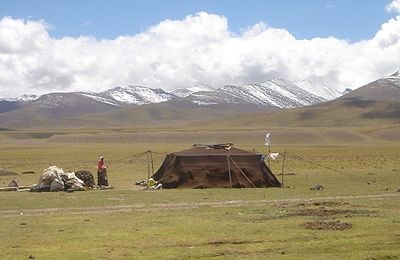
The other night in my mobile living room (aka my computer), Ewan and Charlie were schlepping through Mongolia. And I mean schlepping. Shitty roads no more than a jagged path of boulders with puddles bigger than a circus fat lady, accidents, and other scary stuff filled their days. When they were getting near the end of Mongolia, Ewan commented about how being nomadic was part of the culture in Mongolia and how there was something really nice about that freedom.

As a nomad, I can say it has its ups and downs. I enjoy the simplicity and variety of locations, something that I think Ewan was appreciating too. But sometimes you just wish for your own kitchen, your own routine and your own bed. I think this come from conditioning, however, since in the first world we are not raised to put our clothes and our houses on our back every few weeks to find the next bit of food or avoid a tribal skirmish.

The Mongolians are not alone as nomads. Throughout the third world, in the Middle East and parts of Africa people live in a constant state of movement often for reasons of food or environment. In most first world cultures, a nomadic lifestyle is not embraced or impossible. How could you possibly live as a nomad if you go shop at Macy’s every week? Economist Juliet Schor estimates that in 2004, Americans purchased an average of fifty-seven garments per year. Where are you possibly going to carry all that stuff you keep buying if you needed to pack it up and move on out?

And of course, since I am not buying this stuff, someone is buying my share too. Ouch.

Monday, June 15, 2009

Good Air


Well, I woke up today missing Buenos Aires just terribly. Missing my friends, missing the onda of the city, missing wading into the chaos of a place that is mine and not mine all in an instant. Funny how a place looks from thousands of miles away...

Buenos Aires


Yellow taxis,
yellow walls,
yellow skin.

Damp crisp winter bites my bones.
Chunky crosswalks of thick white lines line the path home.

The glow of green lights goes up the boulevard as we barrel north.
The clatter on the radio calling cars to Chacarita, Cordoba, Corrientes.

Streets the span of a redwood tree
Cars shooting through the intersection like a rocket into space
Motorcycles flying like a shooting star through the cloudy nighttime sky.

Trees line the avenues,
Silent sentinels in bursts of dusty green and gold.
Collectivos screaming down the street
Every corner is a suicide mission to the other side.
The chaos of the city has its own rhythm and rhyme.
Heavy air tinged with the toxic waste exhaust of the cars
that clunk and fume into my open window.

The roaring of the motorcycles
The barking of the dogs
The crying of the children.

La gente, la gente, la gente there.
Living in the good air.

Wednesday, June 10, 2009

Back to the Roots


I am in Florida this week, South Florida to be exact. Part of me feels like I am in Latin America here in Florida, which is sort of nice. There’s tons of Spanish everywhere and not just the service personnel, which is all too common up north.

Yesterday I went to the clubhouse where my mom lives to run on the treadmill. I briefly considered running outside but the hot, sticky air was clinging to me like a size 4 dress – even at 9am. I knew breathing outside and trying to run was going to be virtually impossible so I retreated indoors to the clubhouse of a development reminiscent of Jerry Seinfeld’s fictional Del Boca Vista, replete with old Jewish ladies from whatever northeast city you’d like to name.

They were lovely, these girls with grey hair all pumping iron just as hard as Ar-nald. Delray Beach became Venice Beach right before my eyes. These girls of steel were not alone in their quest for physical perfection – they had a fearless leader, a tiny woman who ruled with an iron fist in a velvet glove, pushing the Jewesses to keep it moving to keep their heart rates up. She was one of those beautiful women who had aged gracefully, retaining the body of her youth in tight spandex with a faced lined with just a few tributaries of her true age.

I chatted with the gals and was quickly invited into the inner circle of exercise culture in Del Boca Vista. They asked about what I was doing and when I told them I was wandering around South America, they looked at me with a bit of shock. One asked, “You did that all by yourself? Is that safe?” I responded, “Yes and yes.”

I continued to talk about how I loved South America, how wonderful the people were and that I had about the same amount of fear wandering around Boca Raton on a dark night as I did wandering around most cities in Latin America. Velvet glove, who it turned out was from Venezuela, grinned at me. As we were walking out, she said to me, “You know, I am 55 years old and I have traveled all around the world, Europe, Asia and the US doing the same kind of thing you are doing.” She also explained how her family had come from everywhere to end up in Venezuela, so she grew up understanding just how big the world was and always wanted to know it all.

Most of our families ended up wherever they are today as immigrants, but before too long we all seem to forget where we came from. In the US, within just a few generations we are assimilated as full-blooded North Americans, leaving our curiosity about where we came from back with our great grandmas. In Latin America, all of my friends knew where their families came from and were still connected to it through culture and custom. Is this because they lack a singular national identity? I don’t think it is that simple, but I just recall how every Argentine I met would tell me about where their families came from while I have some friends here in the US who I have known for years that I have no idea where their families come from. What is it about North American culture that makes us forget our roots?

Tuesday, June 2, 2009

New York, New York


The tour of the north continues. This week I am staying in Brooklyn and dodging into the city here and there, but mostly camping out in the borough because it is generally so much more livable. The amazing thing about New York (and something it shares with Buenos Aires) is the range of possibilities that are available in one city.

A friend of a friend has loaned me her bike and I rode all over Brooklyn yesterday. It was an inadvertent adventure that unfolded while going from friend to friend to home last night. I rode through Prospect Park after 9 pm, the chill of spring still clinging to the trees and hovering around the lakes and ponds and assorted bodies of water that dot the park. I took joy in the ride home, downhill to the end, even crying out a “yeaaah” as I flew down the other end of the slope that would spit me towards Coney Island on the other side of the park. Ah, my idea of zen.

I even took a bike tour of Brooklyn on Sunday with some friends. We weaved in a line from the Hasidic Jews of Kensington to the Asian in Sunset Park and through the little ghettos of Latins and African Americans sprinkled throughout Brooklyn. Then we hit Red Hook, a hipster enclave laced with projects to stop for a view of the State of Liberty and a snack. A friend remarked how we had been on a world tour in an hour or two and all without an airplane.

There are other New Yorks too… for example I went out on Friday night and was introduced to some new friends, a couple from Uruguay. I immediately loved their accents (reminded me of Buenos Aires) and their warm, fun and highly social manner. These lovely, colorful butterflies and I flitted all about the Lower East Side until the wee hours of the morning, drinking cocktails, chatting in Spanish, and just reveling in the glow of the NYC nightlife. We snaked our way into bars that were in buildings two layers back from the street, speakeasy style that served drinks in teacups and beers in paper bags. We ran into an Argentine friend of mine on the street outside another, all chatting in Spanish as we made introductions and shared some drinks at the next bar.

It is only the greatest cities in the world that can allow you such extremes- to go from being a hippie girl on her bike, hair fluttering in the breeze as she rolls through the park to glam bar hopping in Spanish. While New York doesn’t make me miss BsAs, it reminds me how much I love the city life pretty much everywhere in the world.